Episode 10· · Thursday's AI news
Claude looks at your spending, OpenAI's cyber model and an IPO in 2027
Anthropic let Claude read your bank accounts, OpenAI released a cybersecurity model and talked up an IPO, Meta warned data centers will get harder to build, and Airbnb dated its AI travel agent.
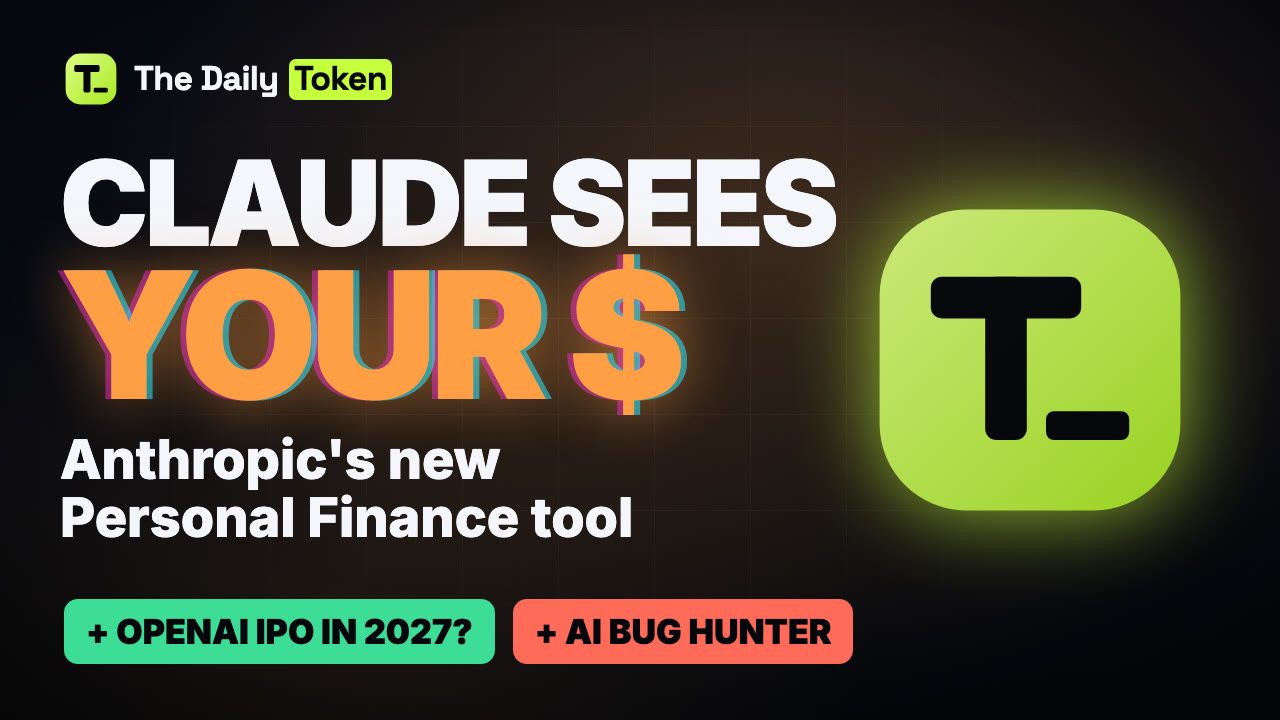

Thursday, November 5, was a day when AI companies asked for a little more of our trust. Some of it was very personal: Anthropic now offers to let its Claude chatbot look at your bank accounts. Some of it was about the software the world runs on: OpenAI released a new AI model built for cybersecurity work. And some of it was about money and power, literally.
OpenAI's president, Greg Brockman, said the company could be ready to go public next year. Meta's president, Dina Powell McCormick, warned that building data centers is going to get harder after the US midterm elections. And Airbnb said its own AI travel agent will arrive in the first half of 2027.
Here's what happened, in plain English.
Claude can now look at your spending
On Thursday, Anthropic, the company behind the Claude chatbot, announced a new feature called Personal Finance. The idea is simple: you connect your bank and credit card accounts, and then you ask Claude about your money in your own words.
The examples Anthropic gives are the kind of questions most of us ask ourselves at the end of the month. Where did my money go? Is this month's spending unusually high? Claude adds up your spending across the accounts you connected and sorts it into categories, like housing, dining and shopping. Anthropic says it can also flag things that are easy to miss, like a charge that hit twice, an unexpected fee, or a bill that has crept up all year. According to TechCrunch, it can also estimate how much interest you paid over the past year and explain terms like APR.
The connection goes through Plaid. Plaid is a company that sits between apps and banks: you sign in to your bank through it, so Claude never asks for or sees your bank password. Once an account is linked, TechCrunch reports that Claude can see things like the bank's name, the account type, the last four digits of the account number, balances, credit limits and up to 2 years of transaction history.
Anthropic is careful about the limits. It says access is read-only, which means Personal Finance can't move, manage or invest your money. It says conversations inside the Personal Finance hub aren't used to train its models (chats elsewhere in Claude follow your normal privacy settings), and that the feature has "no ads or sponsored recommendations." You can unlink an account at any time, and Claude then can no longer see its data.
Anthropic also says the tool isn't designed to give investment advice, that Claude can make mistakes, and that you should check important figures with your bank.
Personal Finance is rolling out in beta this week to people on the paid Pro, Max and Ultra plans, and only in the US. A beta is an early version that is still being tested and improved.
It isn't the first of its kind. TechCrunch points out that OpenAI launched similar personal finance features for ChatGPT in May, and that Anthropic has been moving Claude into new areas this year, including law and financial services. As TechCrunch puts it, some people will have reservations about connecting their bank accounts to an AI chatbot. That is probably the real test for features like this: not whether the math works, but whether people feel comfortable handing it over.
OpenAI's new cybersecurity model
Meanwhile, OpenAI released a new AI model built for cybersecurity, according to TechCrunch.
First, a quick word on what that means. A vulnerability is a hidden flaw in software that a hacker could use to break in. Security researchers spend their days hunting for these flaws so they can be fixed before attackers find them, and AI models are getting very good at that job.
OpenAI runs a program for security professionals called Daybreak. Its Daybreak Blue tier gives defenders access to powerful general AI models. The new model goes to the top tier, Daybreak Red, which TechCrunch describes as giving offensive security researchers, the people who test attacks to find weak spots, tools for hunting vulnerabilities. OpenAI says it wants to expand Daybreak to organizations of every size, independent researchers and the volunteers who maintain open-source software. It says "thousands" of security professionals are already in the program.
A day earlier, OpenAI said its AI had been used to scan the Linux kernel, the core of the widely used Linux operating system, and prepare fixes, finding 948 potential issues. It also said it found 81 "novel" vulnerabilities in the Firefox web browser. Those are OpenAI's own numbers. OpenAI also announced a $1 billion initiative to support security professionals in the program who protect critical infrastructure, like the electrical grid and water systems.
To show how fast this is moving, TechCrunch talked to Max Justicz, the co-founder and chief technology officer of a startup called Charge Robotics, who hunts for bugs as a hobby. Using GPT 5.6 Sol, an earlier OpenAI model, through Daybreak Blue, he found a severe vulnerability that could let hackers take control of servers running Ubuntu, a popular Linux-based operating system. He says he simply pointed ChatGPT at the code, told it about a bug he had found there years ago, and asked it to find something as bad or worse. It came back in 2 hours. The bug was reported to the Debian Project, which issued a patch, and there is no known evidence that anyone exploited it. Justicz told TechCrunch he spent about $5,000 on subscriptions and tokens to find several exploits.
His warning is blunt. He told TechCrunch to expect "some extremely crazy bugs to be found and exploited" in the next few months. OpenAI researcher Eric Wallace has said the company is now putting a significant amount of its most advanced computing power toward finding and patching vulnerabilities.
TechCrunch's question, in its headline, is whether that is enough. The same AI that helps defenders find flaws could help attackers too, and TechCrunch suggests that if there is only a narrow window to patch the software the world depends on, more urgency may be required.
OpenAI could be ready for an IPO in 2027
Next up, OpenAI and the stock market. On Wednesday, at a Wall Street Journal tech conference, OpenAI's co-founder and president, Greg Brockman, was asked whether the company could be ready for an IPO next year, TechCrunch reports.
An IPO, or initial public offering, is when a private company starts selling shares on the stock market, so anyone can buy a piece of it. Brockman's answer: "I think so. Yes." He added that OpenAI would go public when the timing feels right, and that he feels "extremely good about the business."
He was also fairly candid about the year so far. He said the first two quarters of 2026 were "pretty rough" for OpenAI's enterprise business, meaning its sales to companies. And he admitted OpenAI wasn't part of the conversation around agentic coding, AI tools that write and fix code on their own, where Anthropic's Claude Code has gained market share. "We had Codex, but no one was talking about it," he said, referring to OpenAI's own coding tool.
Things have picked up since then. According to TechCrunch, OpenAI's annualized revenue, a yearly pace based on recent sales, grew 70% in the third quarter compared with the second. Brockman credits business customers, saying enterprise revenue doubled. Businesses now bring in the majority of OpenAI's revenue, up from around 30% before, though consumer revenue has kept growing too. He pointed to a recent partnership with JPMorgan Chase as an example of the kind of client OpenAI is now winning, and said the company has learned how to build trust and show it can be a reliable long-term partner.
None of this is a filing or a date. It's an executive saying the company could be ready. But it's a clear signal of where OpenAI sees itself heading.
Meta warns that data centers will get harder to build
Now, back to data centers, which turned into an election issue in this week's US midterms. At the same Wall Street Journal conference on Wednesday, Meta's president, Dina Powell McCormick, said the Democratic wins in the midterms are going to make it a lot harder for companies to build data centers, according to TechCrunch.
A data center is a giant building full of the computers that run AI and the internet. They use a lot of land and a lot of electricity, and local opposition to them has been growing. "The visible sort of manifestation of AI is a data center," Powell McCormick said.
She was frank about the industry's part in that. She said it has not done as good a job as it needed to explain the benefits of these investments, and that there is a bigger issue underneath: how people feel about AI in general.
Meta has data centers in 23 states, she said, and 5 of its projects, including one in Texas, are planned at 1 gigawatt or more of power, which is a lot of electricity. Meta has been building data centers for 20 years. She described what Meta thinks makes a project succeed: paying for its own electricity, sending any tax surplus from a data center to teachers and first responders, hiring locally, and winning support from both parties. Even so, she expects projects to face more review, with communities weighing whether residents really want them.
On the business side, TechCrunch notes that Meta is counting on its consumer AI agent, Muse, growing far beyond the 10 million users it has today. And Powell McCormick said Meta gets calls every day from companies that want to lease the computing power it has built, which she sees as one way to make money from all this building.
Airbnb's AI travel agent gets a date
And finally, travel. On Thursday, Airbnb reported its third-quarter results and said its own AI agent will launch to travelers in the first half of 2027, TechCrunch reports. Until now, the company had only said to expect it within the next year.
Airbnb's CEO, Brian Chesky, has argued for a while that people won't use one AI agent for everything, and that general-purpose agents aren't the best tools for planning a trip. So instead of answering with a wall of text like a typical chatbot, Airbnb says its agent will build a travel-specific screen around your question, drawing on a library of hundreds of interface pieces, like maps, photos, comparisons, calendars and itineraries. Chesky said it will feel "a little bit like generative UI," which basically means the app designs its screen on the fly around what you asked.
The agent is also meant to help after you book: changing a reservation, sorting out payment problems, refunds, rebooking and 24-hour safety support. Airbnb's shareholder letter argues that these are things an outside agent can't easily do on its own, drawing on nearly 20 years of connecting hosts and guests. Over time, Airbnb says the agent will cover services and experiences too, not just homes and hotels.
The business backdrop is good for Airbnb. Revenue grew 19% to $4.87 billion in the quarter, ahead of Wall Street's estimates, and the company raised its growth forecast for 2026. Chesky said Airbnb is "back in growth mode."
The big picture
Put Thursday's stories side by side and a pattern shows up: AI is asking for more of our trust, in more places at once.
Anthropic wants people to trust Claude with their bank statements, and it leans on read-only access, no ads and no training on those chats to earn it. OpenAI wants security teams, and the public, to trust that AI will find software flaws faster for defenders than for attackers, while independent researchers warn that a wave of new bugs is coming. Brockman wants investors to trust that OpenAI's business has turned a corner. Meta's president admitted that the industry hasn't earned enough trust from the towns where its data centers go. And Airbnb is betting that travelers will trust an agent built by the company that already holds their booking, rather than a general chatbot.
None of these questions will be settled this week. But they are the ones to watch as AI moves from something you chat with to something that handles your money, your software and your trips.
Sources
- Anthropic: Introducing Personal Finance in Claudeclaude.com
- TechCrunch: Claude can now analyze your spending with its new Personal Finance tooltechcrunch.com
- TechCrunch: OpenAI released a new cybersecurity model. Is that enough?techcrunch.com
- TechCrunch: OpenAI president Greg Brockman says company could be IPO ready in 2027techcrunch.com
- TechCrunch: Meta warns that election backlash against data centers could make AI expansion hardertechcrunch.com
- TechCrunch: Airbnb says it's launching an AI travel agent in the first half of 2027techcrunch.com
Benchmark, pricing, sales and safety claims are the companies' own unless stated otherwise. This is news and analysis, not financial advice.