Episode 4· · Thursday's AI news
Alphabet has its worst day ever, Amazon spends big, and Mistral opens its biggest model
Investors pushed back on the cost of AI as Alphabet and Amazon showed how much they are spending, while Mistral released an open model, Canada backed Cohere, Reddit moved toward logins and OpenAI rewrote its Model Spec.
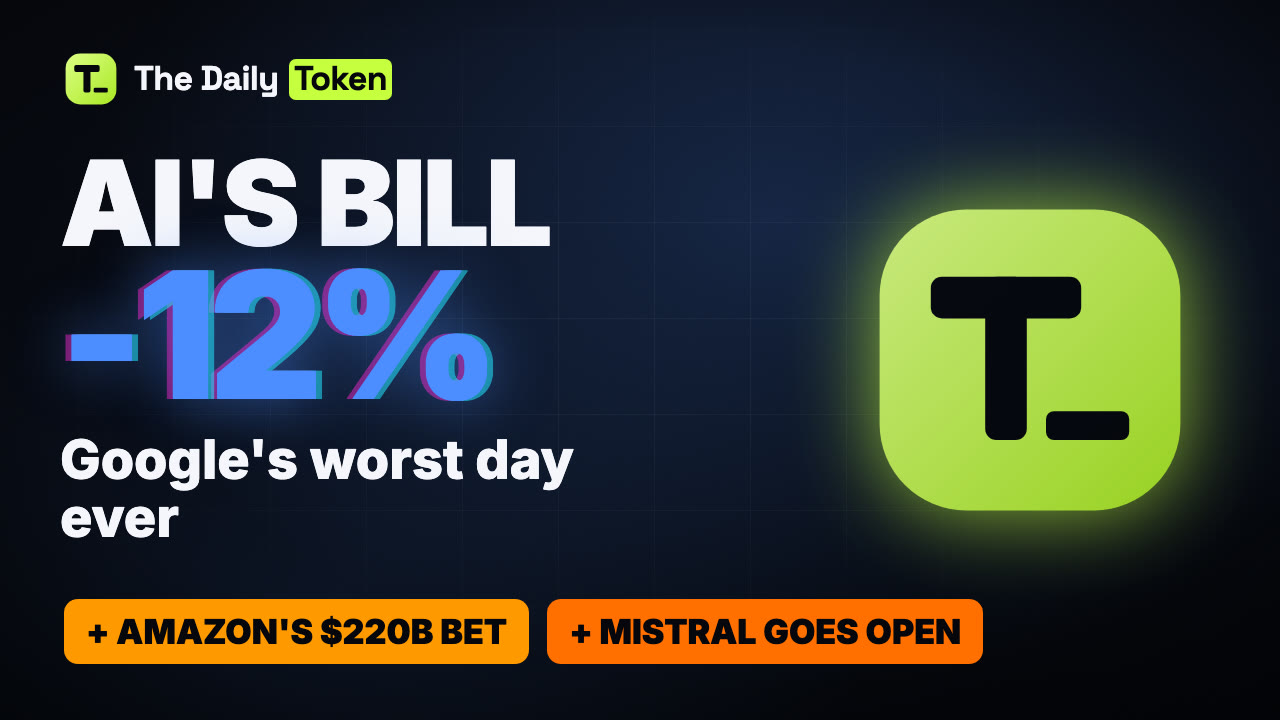

Thursday, October 29, was a day about money, and about how much of it AI is eating. A day after Alphabet's results, its shares had their worst day ever. That evening, Amazon reported its fastest cloud growth in almost five years, and its shares fell anyway. In both cases, the worry was the same: these companies are spending enormous sums on data centers and chips, and investors want to know when that pays off.
Around those two stories, the rest of the day showed AI reshaping things in other ways. The French company Mistral released its biggest model for anyone to download, Canada's government put money into its homegrown AI company Cohere, Reddit said it will start asking people to log in to read it, and OpenAI published a rewritten version of the rulebook it uses to describe how its AI should behave.
Alphabet's worst day ever
On Wednesday evening, Alphabet, Google's parent company, published its results for the July to September quarter. We covered them in the previous episode: Google Cloud roughly doubled, but growth in search, still Google's biggest business, slowed down, and the shares slipped in late trading.
On Thursday, that slip turned into a fall. Alphabet's shares dropped about 12%, which Gizmodo describes as the company's worst day ever. The Financial Times and Bloomberg put the market value lost at around $500 billion, a record for a single day.
What spooked investors comes down to two things. The first is cash. Free cash flow is the money a company has left after paying its bills and paying for long-lasting things like buildings and equipment. It's a rough measure of how much a business is really bringing in after its investments. According to Gizmodo, Alphabet's free cash flow for the quarter was negative, at about $9.07 billion. The reason is how fast it is building. The Register reports that Alphabet spent $51.4 billion in the quarter, about two-thirds of it on servers and networking equipment and the rest on data center construction. It kept its forecast of $195 billion to $205 billion in spending for this year, and it plans to spend significantly more in 2027.
The second is search. Google's search revenue grew 12% in the quarter, down from 17% the quarter before, as Quartz notes. Philipp Schindler, Google's chief business officer, tied part of the slowdown to "lower monetization we were seeing in AI Mode," according to The Register. AI Mode is Google's chatbot-style search, where you get a written answer instead of a list of links. In plain terms, those searches bring in less advertising money than regular ones, at least for now. Schindler argued that this will improve, and Google has started showing ads in AI Mode in more countries.
It is worth keeping the picture in proportion. Across the four biggest spenders, results were mixed. Gizmodo points out that Microsoft was the only one of the four with positive free cash flow this quarter, and its shares rose after its report. Meta's free cash flow came in at negative $2.12 billion.
Amazon's cloud booms, but the spending worries investors
After the market closed on Thursday, Amazon reported, and the story looked familiar.
The good news came from Amazon Web Services, or AWS, the part of Amazon that rents computing power and storage to other companies. Its sales grew 39% to about $46 billion in the quarter, which Amazon's release calls its fastest growth in nearly five years. Amazon says AWS now runs at $184 billion a year. Amazon's total sales were $201.9 billion, up 12%.
Andy Jassy, Amazon's CEO, used the call with analysts to make the long-term case. TechCrunch reports that he said AWS could become a trillion-dollar revenue business in the next 5 to 10 years, and that it can grow by more than 40% in each of 2027 and 2028. He also called the moment "a once-in-a-lifetime opportunity," according to Fortune.
Getting there costs a lot. Fortune reports that Amazon's capital spending, the money it puts into buildings and equipment, was $75.9 billion in the quarter alone. Amazon still expects about $220 billion for the whole of 2026, most of it for AWS, and it says 2027 will be meaningfully higher. That has changed Amazon's cash picture. According to Fortune, its free cash flow over the past 12 months went from a positive $14.8 billion a year earlier to a negative $42.4 billion. Profit for the quarter was $20.7 billion, lower than a year earlier, which Amazon put down to gains from its investment in Anthropic that it booked last year.
Investors focused on the spending. Amazon's shares fell about 6% in after-hours trading. Its forecast for the holiday quarter also came in below what analysts expected at the midpoint, Fortune says.
One more detail from the call is worth noting, because it says something about where AI is heading. Talking about AI shopping assistants from other companies, the kind that can browse and buy for you, Jassy said few customers are shopping that way yet, because "the experience is still not great."
Mistral releases its biggest model as open weights
Meanwhile, in Europe, the French AI company Mistral released the weights of Mistral Large 4, its biggest model, nicknamed "Le Chonk."
That needs a little explaining. Most of the best-known AI models, like the ones behind ChatGPT or Claude, only run on their makers' servers. You can use them, but you can't take them home. A model's weights are the settings it learned during training, the part that makes it work. When a company releases open weights, it publishes them, so anyone can download the model, run it on their own computers and adapt it. Large 4 is available on Hugging Face, a popular site for sharing AI models. Mistral's license allows people to use, modify and sell products built on it, but companies that want to offer it as a paid hosted service need a separate commercial license.
Mistral describes Large 4 as a 1-trillion-parameter model, which is a rough measure of its size, and says it was trained from scratch on European infrastructure. It says the model is especially strong at writing code and at cyber defense. By Mistral's own numbers, it is the best open model for coding, and according to Fortune the company calls it the best open model built in the West. VentureBeat frames it as the top open model outside China. Those claims come from the company and haven't been independently checked.
Pierre Stock, Mistral's vice president of science, told Fortune the release was "a pivotal moment in the global AI race." His pitch to businesses is control. Customers in regulated industries ask most of all for business continuity, he said, and once a model's weights are public, "it's impossible to cut off access."
There are limits to keep in mind. On Terminal-Bench 4.0, a coding test Fortune looked at, Mistral says Large 4 scored 41%, while the best closed models still score far higher. And Mistral is much smaller than its American rivals. Fortune puts its total funding at about $6 billion and its latest valuation at over 21 billion euros, compared with $965 billion for Anthropic. For developers who pay to use it through Mistral's own service, the company lists prices of $0.70 per million input tokens and $2.10 per million output tokens. A token is a small chunk of text, roughly part of a word.
Canada invests in Cohere
Staying with countries that want AI of their own, Canada's government said it will invest up to 1.6 billion Canadian dollars in Cohere, a Toronto company that builds AI for businesses and governments. Prime Minister Mark Carney announced it in Montreal, and The Canadian Press reports that the money will come in stages, with regular reporting on what the company has promised.
"We are not waiting for the future of AI to be decided somewhere else," Carney said. That sums up an idea often called sovereign AI: a country wanting AI it controls at home, under its own rules, instead of relying only on foreign companies.
The government's money is part of a much bigger funding round. According to Unite.AI, Cohere completed the first close of a round that could reach 7 billion Canadian dollars, at a valuation of 35.7 billion Canadian dollars. The Government of Canada is taking an equity stake, meaning it will own part of the company. Germany's Schwarz Group leads the round, with Nvidia and the Canadian telecom company Bell among the other investors. Cohere CEO Aidan Gomez called it "a record-setting round."
In return, The Canadian Press reports, Cohere commits to creating at least 1,000 new high-paying technical jobs in Canada, putting at least $1.7 billion into computing infrastructure by 2030, and keeping its headquarters in the country. It isn't the first time Ottawa has backed Cohere: in 2024, it committed up to $240 million for the company's computing capacity. Earlier this year, Cohere also announced plans to merge with Germany's Aleph Alpha.
Reddit moves toward logging in
Next, Reddit. Today, most of Reddit can be read without an account, often after clicking a Google search result. That is set to change. In a letter to shareholders, CEO Steve Huffman said Reddit will move to a mostly logged-in experience, Engadget reports. It will test the change first in "select markets" outside the US, and there's no date yet for a wider rollout. Huffman said some version of Reddit will stay open for things like shared links.
Part of the reason is search. Reddit says its traffic from search was "down meaningfully" last quarter, with search referrals falling by more than 1 million a week in October. Huffman pointed at Google's AI Mode, which answers questions directly instead of sending people to websites. "It used to be a traffic driver, now it's not," he said, according to Engadget.
Logged-in users also help Reddit in other ways. They give it more information for targeting ads, and they tend to use the site more. And requiring a login makes it harder to scrape the site. Scraping is when automated programs copy a website's content, often to train AI models. Reddit does sell access to its posts: it has a licensing deal with Google, reportedly worth about $60 million a year, and Huffman said the two companies are in "active discussions" about it. Axios also covered the shift.
It is a small example of a big change. When a chatbot answers a question for you, fewer people click through to the sites the answer came from, and those sites have to find other ways to keep their audience.
OpenAI rewrites its Model Spec
And finally, OpenAI published an updated Model Spec. The Model Spec is OpenAI's public description of how it wants its AI models, like the ones in ChatGPT, to behave. Think of it as a rulebook for the AI, written down so that people outside the company can read it.
The new version organizes that guidance around five values: faithfulness to human intent, meaning what people actually want; harm minimization; honesty and transparency; human agency, meaning respect for people's own choices; and care. OpenAI says the update also adds guidance on context, on oversight, meaning people's ability to check and correct the AI, and on how much the AI should do on its own. It adjusts some default behaviors and drops much of the detailed guidance on writing style.
OpenAI is open about the gap between the document and reality: it says its models don't yet fully behave the way the Spec describes. It's best read as a statement of where the company wants them to go. As AI assistants start doing more on their own, documents like this are one of the few ways the public can see how they are meant to make decisions.
The big picture
Thursday's thread was cost. Alphabet and Amazon are both growing fast in the parts of their business that sell AI computing, and both say demand is strong. But they are spending at a pace that pushes their cash flow below zero, and investors reacted by selling. The question is no longer whether people want AI, but when all this building turns into profit.
The other stories show who else is trying to shape how AI works. Mistral is betting that businesses will want models they can run and control themselves. Canada is betting public money that a country should have a strong AI company of its own. Reddit is changing how people reach it because AI answers are changing how people find things online. And OpenAI is publishing more detail about the rules its AI is supposed to follow. Each of these is a response to the same shift: AI is becoming part of how money, information and the web itself move around.
Sources
- TechCrunch: AWS will be a $1T business, Jassy says. But first, it will spend big.techcrunch.com
- Fortune: Amazon shares sink as spending on AI overshadows growth in cloud unitfortune.com
- Amazon: Third quarter 2026 resultssec.gov
- Gizmodo: Amazon's $42.4 billion cash burn delivers final blow in a rough week for AIgizmodo.com
- The Register: Google struggling to make AI Mode searches paytheregister.com
- Search Engine Journal: Google's Q3 selloff raises advertiser concerns about AI searchsearchenginejournal.com
- Quartz: Google is taking AI Mode search ads global as search revenue growth slowsqz.com
- Mistral AI: Mistral Large 4 (Le Chonk) is now open weightmistral.ai
- Fortune: Mistral says its new model, Large 4, achieves 'frontier' performance among open modelsfortune.com
- VentureBeat: Mistral Large 4 'Le Chonk' arrives as the top open model outside Chinaventurebeat.com
- The Canadian Press (Global News): Ottawa to invest up to $1.6B in Canadian AI firm Cohereglobalnews.ca
- Unite.AI: Cohere closes initial Series E targeting up to CAD $7B at CAD $35.7B valuationunite.ai
- Engadget: Reddit will force users to log in as AI is killing search trafficengadget.com
- Axios: Reddit moves to logged-in experience as AI eats searchaxios.com
- OpenAI: An updated Model Spec for more capable and beneficial AIopenai.com
Benchmark, pricing, sales and safety claims are the companies' own unless stated otherwise. This is news and analysis, not financial advice.